

Ultimate Pool League
General Rules
SPORTMANSHIP FOULS
UPL is played in a fair, respectful, and sportsmanlike manner at all times. Players are responsible for knowing the rules and conducting themselves appropriately. Unsportsmanlike conduct may result in penalties including standard fouls, loss of rack, or further disciplinary action at the discretion of league officials.
Sportsmanship Violations (LoR)
Loss of Rack foul may be issued for serious sportsmanship violations, including, but not limited to:
(a) A second offense of foul or abusive language during the same match (a verbal warning will be issued for the first offense)
(b) Throwing, striking, or unscrewing a cue in a manner that suggests concession of the rack or displays unsportsmanlike conduct
(c) Repeatedly arguing with the opponent, referee, or match officials after a ruling has been made
(d) Interfering with an opponent while they are at the table, either verbally or physically
The League Operator or referee may issue additional penalties if the conduct is deemed serious, repeated, or disruptive to league play.
Arguing, cussing, fighting, or any type of misconduct can result in suspensions or lifetime bans. If there are any issues, please speak directly to your team captain or co-captain. They will relay any concerns to the league operator.
Any action deemed to be a sportsmanship foul during play will first receive a warning, and second will result in forfeiture of the current match with possible suspension from League.
TEAM REQUIREMENTS
To ensure fair competition, teams must have a roster that meets these per match requirements:
(1) player rated 700+ or (2) players rated 600+
(1) player 450 or below
You can play any combination of ranks per night as long as the above is followed.
Technically you could play a 999 - 599- 599 - 599 - 449. That's the absolute strongest allowed lineup you can play in an individual match.
ALL RANKS CAN PLAY CONSISTENTLY!
COACHING
Coaching is permitted only for players rated 450 UPScore or below, and only during a extension.
• The player or the coach must request the timeout.
• Once a timeout has been called, it must be used.
• If a coach calls for a timeout and one has already been used, it will be a ball in hand foul, with ball in hand awarded to the opponent.
• If this occurs again during the same team match, the team will be issued a sportsmanship foul and the player will lose the current rack.
• If a player requests a coaching timeout after their extension has already been used, the request will be denied by the scorekeeper and no foul will be issued.
• If any other individual calls for a timeout, it will result in ball in hand for the opponent.
• The extension must be selected on the scoring app before the coach approaches the table.
• If a coach calls for a timeout for a player rated 451 or higher, it will be a ball in hand foul, with ball in hand awarded to the opponent.
• The match clock continues to run during all timeouts.
HANDICAPS & SKILL RATINGS
Matches are handicapped using UPscore, UPL’s national rating system. The higher rated player will spot the lower rated player (1) rack for every 40 point difference in Upscore with a max of a (4) rack spot. With the matches being played on a 30 minute clock, this puts extreme pressure on the higher rated player to rundown their opponent and be in the lead when the clock strikes 0:00.
For example:
550 vs 530 = no handicap
550 vs 500 = (1) rack spot
550 vs 300 = (4) rack spot
Ultimate Pool League
8-Ball Rules
THE LAG
A lag determines which player breaks first. Each player simultaneously strikes a ball from behind the head string toward the foot rail. The player whose ball comes to rest closest to the head rail wins the lag.
Players must strike their lag shots at approximately the same time. If one player’s ball reaches the foot rail before the opponent’s ball is struck, the lag will be replayed.
If both players commit a lag foul or the result cannot be determined, the lag is replayed. Breaks alternate after the first rack unless otherwise specified by match format.
A player automatically loses the lag if their ball:
- Crosses into the opponent’s half of the table
- Fails to contact the foot rail
- Contacts a side rail
- Is pocketed
- Leaves the table
- Stops in the jaws of the corner pocket
THE RACK
UPL format is rack-your-own.
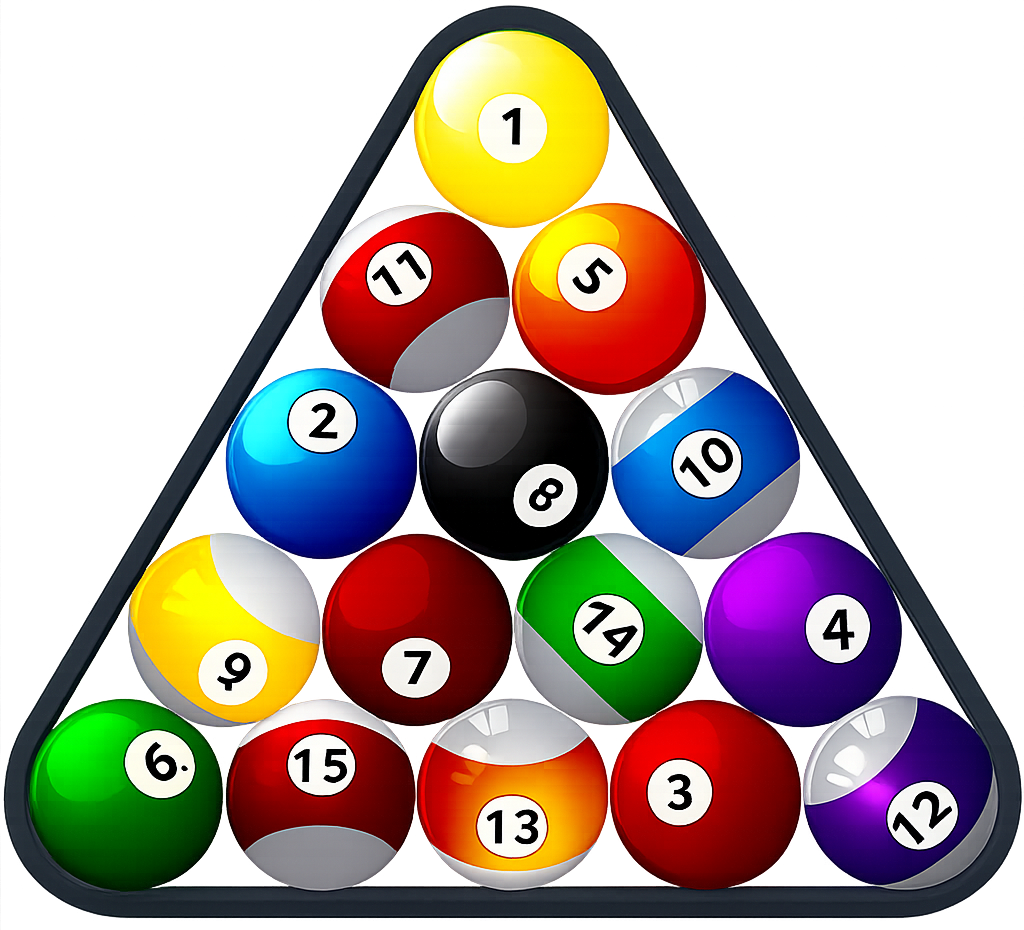
The object balls must be racked in the official UPL rack pattern with the 8-ball on the spot. Ball placement is determined by group, not by individual ball numbers. See graphic below dropdown list.
The rack must be tight and properly aligned before the break shot is taken. If the rack is incorrect before the break, the balls must be re-racked. If the rack is incorrect and the break occurs, the result of the break stands and play continues.
THE BREAK
UPL Format is alternating breaks.
Cueball can be placed anywhere behind the head string. Maximum of less than half the cueball may be over the headstrong line.
3 Point Break
To perform a legal break, the breaker must earn a minimum of three cumulative points:
• 1 point for each object ball pocketed (including the 8-ball)
• 1 point for each object ball that completely crosses the center of the side pocket
Illegal Break - The balls must be re-racked. The opponent then chooses who breaks.
OPEN TABLE
Balls pocketed on the break do not determine groups. The table is considered open immediately after the break. Groups are assigned when a player legally pockets a ball after first contacting and pocketing a ball from the intended group.
If the intended group (solids or stripes) is not obvious, the player must clearly declare their intended group before the shot is taken. Failure to declare the intended group when it is not obvious will result in a loss of turn. If both a solid and a stripe are pocketed in the same shot, the player’s group is determined by the intended group that was struck first by the cue ball.
If a player strikes one group first but pockets only a ball from the opposite group, it is loss of turn and the table remains open.
Groups cannot be assigned on a foul shot.
If the cue ball is touching (frozen to) an object ball while the table is open, the player must declare the intended group before the shot is played. Failure to declare the intended group will result in a loss of turn.
8 on the break
If the 8-ball is pocketed on the break the player spots the 8 ball and keeps shooting. It is re-spotted on the foot spot after all balls have come to rest. If the foot spot is occupied, the 8-ball is placed as close as possible on a direct line between the foot spot and the center of the foot rail. If that position is not available, place the 8-ball as close as possible on a direct line between the foot spot and the center of the head rail. (think one-pocket)
You can not win or lose on the break.
Scratch on the break
If the cue ball is pocketed (scratch) on the break, the incoming player receives one visit with cue ball in hand behind the head string and may shoot in any direction. If the cue ball leaves the table on the break, or commits any other standard foul, other than scratching into a pocket, the incoming player receives cue ball in hand anywhere on the table.
LEGAL SHOTS
To play a legal shot, the cue ball must first contact a ball from the player’s own group. After that contact, the shot must result in either:
- A ball being pocketed (except the 8-ball when it is not legally on), or
- The cue ball contacting a rail, or
- Any object ball contacting a rail
If these requirements are not met, the shot is a standard foul (Ball-in-hand)
Combination Shots
- Combination shots are allowed and do not need to be called.
- A player must first contact a ball from their own group before pocketing any ball in a combination shot.
- If a player legally strikes a ball from their group first, balls from either group pocketed during the same shot remain pocketed.
- If a player attempts a combination shot and pockets only an opponent’s ball, it is loss of turn.
- On an open table, the first ball contacted by the cue ball must be from the intended group, and a ball from that group must be pocketed in order to establish groups.
- If a player contacts one group first but pockets only a ball from the opposite group on an open table, it is loss of turn, and the table remains open.
Loss of Turn
A loss of turn occurs when a player fails to pocket a ball on a legal shot but does not commit a foul When a loss of turn occurs, the incoming player plays the cue ball from its current position.
Loss of turn includes:
- Attempting a combination shot that pockets only an opponent’s ball
- Playing a defensive shot that pockets only an opponent’s ball
- On an open table, contacting one group first but pocketing only a ball from the opposite group
- Failing to declare the intended group when required on an open table.
STANDARD FOULS
A standard foul results in the incoming player receiving one visit with cue ball in hand anywhere on the playing surface, unless otherwise specified. When cue ball in hand is awarded, the player may position the cue ball anywhere within the permitted area using the hand or any part of the cue.
The cue ball may be adjusted multiple times until the shot is played. A forward striking motion with the cue while positioning the cue ball is not permitted.
If the cue ball is frozen to another ball when cue ball in hand is awarded, the cue ball must be repositioned before the shot is played.
Standard fouls include:
• Pocketing the cue ball (scratch), except as otherwise defined on the break
• Failing to first contact a ball from the player’s own group
• Failing to complete a legal shot
• Playing a shot before all balls have come to rest
• Playing out of turn
• Playing before balls that require re-spotting have been correctly replaced
• Double-hitting the cue ball
• Playing a push shot
• Playing a shot without at least one foot touching the floor
• Touching or moving any ball with the body, clothing, equipment, or cue
• Striking the cue ball with any part of the cue other than the tip during a legal stroke
• Striking any object ball with the cue
• Marking the table to assist a shot
• Playing from outside the required starting area when cue ball in hand is restricted behind the head string
• Leaving the playing area during a rack without notifying the opponent or match official
• Receiving coaching during a rack when coaching is not permitted under Section 12
• Committing a time violation under the shot clock
• A ball leaving the playing surface and not returning on its own
• Failing to play away correctly from a confirmed frozen or touching ball
• Playing a shot that causes the cue ball to jump over another ball
If the cue ball leaves the playing surface and passes over an intervening ball that it would otherwise have contacted, the shot is considered a jump shot and is a standard foul.
LOSS OF RACK FOULS
A player loses the rack if any of the following occur:
• Intentionally committing a foul
• Pocketing the 8-ball before all balls from their group have been legally pocketed
(except on the break)
• Pocketing the final ball from their group and the 8-ball in the same shot
• Committing a standard foul while pocketing the 8-ball (except on the break)
• Deliberately failing to attempt to contact a ball from their own group
• Deliberately striking the cue ball with any part of the cue other than the tip during play
• Deliberately striking any object ball with the cue
• Deliberately moving any ball other than as part of a legal shot or authorized cue ball
placement (except following an all-ball foul)
• Deliberately stopping a ball in motion while on the playing surface
• Playing another shot or deliberately moving balls after legally pocketing the 8-ball and
before all balls have come to rest
Sportsmanship Violations (LoR)
Loss of Rack foul may be issued for serious sportsmanship violations, including, but not limited to:
(a) A second offense of foul or abusive language during the same match (a verbal warning will be issued for the first offense)
(b) Throwing, striking, or unscrewing a cue in a manner that suggests concession of the rack or displays unsportsmanlike conduct
(c) Repeatedly arguing with the opponent, referee, or match officials after a ruling has been made
(d) Interfering with an opponent while they are at the table, either verbally or physically
The League Operator or referee may issue additional penalties if the conduct is deemed serious, repeated, or disruptive to league play.
Ultimate Pool League
10-Ball Rules
FORMAT BASICS
Roster Size: Up to 8 Players
Handicap based on UpScores
Match Duration: 30 minutes
Shot Time Limit: 30 seconds
Extension: 30 seconds, one per rack
Timeouts: Only Rank 450 and below
SPORTMANSHIP FOULS
Sportsmanship and professionalism are the most important aspects of a league night. Players are expected to behave in a professional and respectful manner at all times during play.
Arguing, cussing, fighting, or any type of misconduct can result in suspensions or lifetime bans. If there are any issues, please speak directly to your team captain or co-captain. They will relay any concerns to the league operator.
Any action deemed to be a sportsmanship foul during play will first receive a warning, and second will result in forfeiture of the current match with possible suspension from League.
Ultimate Pool League
UPL STRUCTURE
Divisions
Locations and nights of the week are organized into separate divisions with their own leaderboards. Players are allowed to compete in as many divisions as desired however, may only play on 1 team per division.
Sessions
Each session consists of 14 weeks of play. The winning teams advance to the Grand Finals Qualifier which determines the teams sent to Nationals to compete for the $100k+
Seasons
A full season = (3) sessions, (1) Grand Finals Qualier Event, (1) Grand National Finals
Locations and nights of the week are organized into separate divisions with their own leaderboards. Players are allowed to compete in as many divisions as desired however, may only play on 1 team per division.
Each session consists of 14 weeks of play. The winning teams advance to the Grand Finals Qualifier which determines the teams sent to Nationals to compete for the $100k+
A full season = (3) sessions, (1) Grand Finals Qualier Event, (1) Grand National Finals